Mission Statement

The mission of re:TH!NK, the Lakeshore Tobacco Prevention Network, is to improve the health of our residents by reducing tobacco use and exposure through prevention strategies which include community outreach and involvement to move policy forward collaboratively, across our multi-jurisdictional area.

Monday, January 19, 2015

MLK Day 2015

Today is Martin Luther King, Jr. Day. A day to remember his dream of equality as well as the work that's been done by many to make that dream a reality.
 
Today I am reminded of my trip this summer to Washington, D.C.
 
While I had been to D.C. before, I had not yet seen the Martin Luther King, Jr. National Memorial that was erected in 2011. I had seen pictures of it's construction and on one of the most beautiful days in May I was finally able to see the Memorial in person. It took my breath away.


After short walk from the Lincoln Memorial where MLK delivered his famous "I Have a Dream" speech in 1963, I entered the Memorial through two slabs of granite. "Out of the mountain of despair, a stone of hope" is inscribed on one slab, a powerful line from MLK's "I Have a Dream" speech.
 
The photo's doesn't do the monument justice. I couldn't capture the immense size and power of the Memorial with a camera.
 
 
Martin Luther King, Jr. day is a reminder to us all that more work is needed to fulfill Dr. King's dream of equality. One particular inequality that stands out to me surrounds tobacco use. The graph below pulls data on the impacts of tobacco and it makes disparities in tobacco use pretty obvious.
 
We've seen tobacco rates declining and in December 2014 the Wisconsin Department of Health Services announced a record low smoking rate of 18%. Unfortunately, compared to the overall number, specific populations (see below graph) did not experience that same all time low.
 
 
It's no coincidence that these populations smoke at higher rates than the state average. Marketing of tobacco products is heavily targeted to these specific communities. And they aren't the only groups disproportionately affected by tobacco. Those affected by mental illness smoke at a MUCH higher rate than the national average. 
 
re:TH!NK and coalitions all throughout the state are working to decrease tobacco disparities in our community by connecting adults with quit smoking resources and involving youth and adults in local tobacco prevention and control activities.
 
Today, on Martin Luther King, Jr. Day, let's remember the dream of equality and the strides we have taken as a country to get there. While work is still needed to achieve equality, we are on our way. We can make Dr. King's dream a reality.
 
-Anna 

Tuesday, December 30, 2014

E-Cigarettes and Wisconsin's Smoke Free Air Law

I recently received a phone call from a woman confused about e-cigarettes. While taking her grandchildren to lunch she noticed people using e-cigarettes inside the building, the same building her grandchildren were eating and playing. She didn’t think e-cigarettes were allowed indoors and after asking the manager, she was told the truth, e-cigarettes are not covered under the Wisconsin Smoke Free Air Law.

So what are e-cigarettes? Whether an e-cigarette looks like a cigarette, a pen, or something completely different, the basic structure remains the same (see photo).


Like traditional cigarettes, the user is not the only person affected by e-cigarette use. The aerosol or “vapor” from e-cigarettes has been found to contain harmful substances like nicotine, propylene glycol, arsenic, aluminum, and lead. Propylene glycol is a known “food grade” substance used to absorb extra water and retain moisture in medicine, cosmetics, and food. While small amounts can be eaten safely, it has not been proven safe when inhaled. Unlike the stomach, lungs do not have acid to break down food and/or chemicals. Most of us can remember accidently inhaling water and the coughing fit that followed. Our bodies know what the lungs need and crave… clean air.

In 2014 Wisconsin reported the lowest smoking rates ever in adults and youth, however, at the same time reports also came in showing a drastic rise in e-cigarette use. Using e-cigarettes indoors re-normalizes smoking. Youth today have never seen a tobacco ad on TV and can barely remember when people could smoke inside public places. E-cigarettes use indoors has the potential to reverse decades of progress in preventing tobacco use and addiction to nicotine.

E-cigarettes are new, unregulated products and the long term effects of use are still unknown. What we do know is e-cigarettes contain nicotine which is an addictive substance, they give off an aerosol containing harmful substances, and they threaten our ever popular State-wide Smoke Free Air Law.

State prevention experts agree, we need to let scientists and the Food and Drug Administration (FDA) do more research on e-cigarettes and until we know more, we need to keep e-cigarettes out of public places.


-Anna

Thursday, December 11, 2014

Hookah

According to the Merriam-Webster Dictionary, hookah is defined as a water pipe. The below picture shows a basic example and the parts of a hookah water pipe. 
(photo from www.cdc.gov)


The tobacco used in hookah is called shisha. Shisha is a moist, sticky tobacco that comes in a variety of flavor. The shisha is heated and burned in the head of the hookah by charcoal. The smoke from the burning shisha and charcoal then travels down the length of the body into the water bowl where the smoke is cooled. A hookah user inhales through the mouthpiece and the cooled smoke travels through the hose and mouth piece into the users lungs.

Because the smoke enters a water bowl before the user inhales people believe smoking hookah is a safe alternative to smoking traditional cigars or cigarettes and the smoke is "filtered" through the water. When in reality the water only cools the smoke, making it easier to inhale.

Smoking hookah is extremely harmful for the lungs. A World Health Organization report showed that about an hour of smoking hookah is as bad for our health as smoking 5 packs of cigarettes (100 cigarettes). And if that isn't scary enough, we've seen a huge increase in the amount of youth and young adults using hookah.

Studies done in the past years have increasing popularity of hookah, 40% of college students have ever smoked hookah. Hookah appeals to young people in a way that is different from traditional tobacco like cigarettes and cigars.

Tobacco Free Florida shared this great, myth busting infographic on hookah smoking based on a survey done by the University of South Florida.


For more information about hookah check out the links below:

The recent articles from Tech Times or Medical Daily


Friday, September 26, 2014

Made in the USA: Child Labor and Tobacco

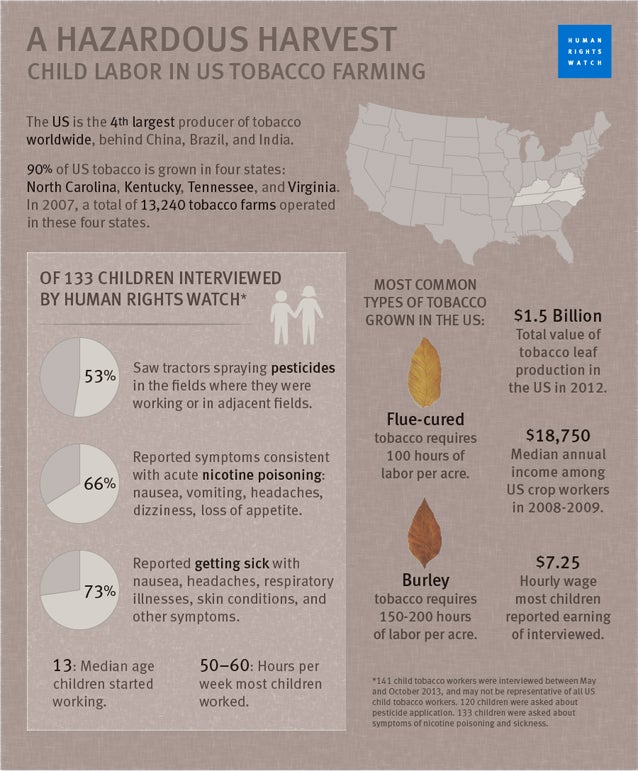
Dangerous farming equipment, extreme temperatures, exposure to toxic chemicals and pesticides, very low pay, young kids working 12+ hour days. Sounds like the description of cheap labor on foreign farms that produce as much as they can at the lowest possible cost- despite the impact on the employees.

That is exactly what is happening, only it's NOT foreign.
It's happening right here in the United States.

In Kentucky, North Carolina, Tennessee, and Virginia U.S. tobacco farms are employing children as young as 12 years old to work on tobacco farms. And all the big tobacco manufacturers and merchants are benefiting from buying the product. Alliance One, Altria (Philip Morris), British American Tobacco, China National Tobacco, Japan Tobacco Group, Lorillard, Philip Morris International, Reynolds American, Universal Corporation.

In an 8-minute documentary by Human Rights Watch (video below) called: US: Child Workers in Danger on Tobacco Farms, the harsh conditions and workers on these tobacco farms are shown.


With good intentions the "made in the U.S.A." movement spreading throughout the country is partially focused on stopping child labor. Instead of buying from other countries, we look for products made in the U.S.A. with a focus on supporting American jobs, the American economy, and saying no to foreign child labor. Unfortunately, exploiting children isn't exclusive to other countries. It's happening right here in the U.S.A.

Big tobacco profits from child labor in US tobacco fields. Take action now:  http://www.hrw.org/ChildFreeTobacco %23ChildFreeTobacco

So what can we do? How can we help?

Watch the documentary. Share the story. Talk with family and friends about the importance of kids being in school. Keep working to reduce tobacco use throughout the U.S.A. and the world. If the demand for tobacco goes away, there will be no need for the supply. Which in turn means there will be no need for cheap labor to produce it (ie. kids).


For more information on the topic take a look at the Human Rights Watch article,
US: Child Workers in Danger on Tobacco Farms | Human Rights Watch. (2014, May 14).