Mission Statement

The mission of re:TH!NK, the Lakeshore Tobacco Prevention Network, is to improve the health of our residents by reducing tobacco use and exposure through prevention strategies which include community outreach and involvement to move policy forward collaboratively, across our multi-jurisdictional area.

Tuesday, September 29, 2015

Halloween!

Halloween is just around the corner and while scary pumpkins, costumes, and horror movies are sure to generate scares, there's a new trend that's even more terrifying: our young people are increasingly turning to new types of tobacco and nicotine products.

Wisconsin's teen smoking rates are currently at all-time lows, and that's news to celebrate! Unfortunately, as high school smoking rates hit lows of 11%, more teens are trying e-cigarettes (or vape pens) than ever before. The Wisconsin high school e-cigarette use rate is at 8%, according to the 2014 Wisconsin Youth Tobacco Survey.

Even more disturbing, a recent study out of Connecticut published in the Medical Journal of Pediatrics showed an estimated 18.7% of the 4,000 Connecticut youth surveyed had used e-cigarettes (or vape pens) to "vaporize" cannabis. More teens using marijuana in any form is a trend no parent, guardian, teacher, health care provider, etc. wants to see. Check out this radio interview and listen to the discussion.


There is little wonder why these products are attracting younger users, since many of them are trendy, electronic, and featuring kid-friendly flavors like gummy bear and cotton candy.

Partners throughout the Lakeshore Tobacco Prevention Network and members of our FACT groups have surveyed tobacco and nicotine products in counties in the MJC (Door, Kewaunee, Manitowoc, Sheboygan, and Winnebago counties). The results of the surveys found products ranging from little flavored cigars, chewing tobacco, and snus to e-cigarettes (or vape pens) and e-cigarette juices. All the products could be found in candy-like flavors.

Thankfully, the Lakeshore Tobacco Prevention Network and coalitions all around Wisconsin are out in the community working to help our kids avoid the frightful fate of tobacco and nicotine addiction. Stay in touch with the recent happenings in tobacco prevention by following our Facebook page!

Tuesday, September 8, 2015

Take me out to the ball game!

Summertime and baseball go together like peanuts and popcorn! As this summer comes to a close, we can reflect on big changes happening at baseball parks from coast to coast. In Boston, San Francisco, and most recently Los Angeles, tobacco has been knocked out of the ballparks.

Data from the national Youth Risk Behavior Surveys published in the CDC's Morbidity and Mortality Weekly Report shows that while the use of combustible tobacco products like cigars and cigarettes has dropped significantly from 2001-2013 in high school students, the use of smokeless tobacco like chew and snus has remained unchanged among non-athletes and has increased among high school athletes.

Athletes may be more likely to use certain tobacco products, such as smokeless tobacco, specifically if they perceive them to be harmless. This highlights the need for greater tobacco education programs, including smokeless tobacco, among youth. Just about any young person you ask will say people shouldn't smoke... unfortunately, smokeless tobacco seems harmless to many, youth and adults a like. And when our favorite childhood athletes are using tobacco, we still look up to them and want to be just like them.

Taking tobacco out of baseball is a great way to get the word out to young people that tobacco is harmful, in any form. Curt Schilling, baseball great, has been a huge advocate for tobacco prevention since being diagnosed with cancer after struggling with an addiction to chewing tobacco for years. He wrote and shared a Letter to My Younger Self about his life and how it could be different if at 16 he did not become addicted to tobacco. One of the many lines that stand out,
"You will get message after message, but your addiction will always win, until it wins the biggest battle... It's difficult for you to understand in this current phase of your life, but by chewing tobacco, you are jeopardizing your participation in what will be some of the your most important moments."
It's stories like Curt's and many others that repeat the importance of keeping tobacco products out of sports. Young people look up to athletes whether they know it or not. By keeping sports tobacco free we can prevent so many young athletes from becoming addicted to tobacco.

From the east to the west coast we've seen tobacco knocked out of parks. As more and more parks do the same, hopefully we will see the number of student athletes using tobacco decline once and for all.


Thursday, August 13, 2015

It's time to go back to school!

It's that time of year again! If they haven't already, many parents will soon be taking their kids to registration and school shopping. And just around the corner are days of making plans for juggling kids' school and after-school activities.


(image from Corbis Images)

One more item for parents to think about is how they can help their kids stay tobacco and nicotine free this school year. While monitoring your child's tobacco use used to be as simple as smelling their clothes for smoke, new tobacco and nicotine products are making the task more and more difficult.

While fewer Wisconsin students are smoking than ever before (only about 1 in 10 high school students), more and more students are trying and becoming addicted to e-cigarettes (aka. vape pens). Youth use of e-cigs tripled in just one year nationally.


Sadly, the candy-like flavors and lower costs lead teens to think smokeless tobacco and e-cigarettes are harmless, when the truth is they carry serious consequences. Like a lifetime addiction to nicotine, countless types of cancer, respiratory problems, and more. Tobacco and nicotine negatively affect almost every part of the body. See graphic below.
http://www.health-e.org.za/wp-content/uploads/2013/09/Harm_from_smoking.jpg


We of course want to end on a positive note and there is good news... re:TH!NK, coalitions, schools, parents, legislators, and others throughout Wisconsin and world are working to reverse the deadly trends of tobacco and nicotine. That's why we continue to do what we do, because we know an impact can be made.

To learn more about our efforts, connect with us on Facebook or email us at rethink@co.winnebago.wi.us!

Thursday, May 28, 2015

World No Tobacco Day

Globally tobacco kills 6 million people each year, of that more than 600,000 are non-smokers affected by second-hand smoke. Without action, by 2030 the epidemic will kill more than 8 million per year and more than 80% of those deaths will be of those living in low- and middle-income countries.
 
On May 31, the World Health Organization (WHO) and it's partners recognize World No Tobacco Day (WNTD). This year, the focus is on ending the illegal trade of tobacco products worldwide.
 
Although it may seem like small problem, illegal tobacco trade affects health as well as economic growth and illegal tobacco sales aren't just happening in some countries. Almost all countries worldwide are affected by illegal tobacco trade with as much as one in every 10 cigarettes consumed globally.  
 
 
The World No Tobacco Day 2015 campaign is focusing it's efforts on the 5 main goals below.
  1. Raise awareness on the harm to people's health caused by the illicit trade in tobacco products, especially the youth and low-income groups, due to the increased accessibility and affordability of these products due to their lower costs.
  2. Show how health care gains and programs, tobacco control policies, like increased tax and prices, pictorial health warnings and other measures are undermined by the illicit trade in tobacco products.
  3. Demonstrate how the tobacco industry has been involved in the illicit trade of tobacco products.
  4. Highlight how the illicit trade of tobacco products is a means of amassing great wealth for criminal groups to finance other organized crime activities, including drugs, human and arms trafficking, as well as terrorism
  5. Promote the ratification of, accession to and use of the Protocol to Eliminate Illicit Trade in Tobacco Products by all Parties to the WHO Framework Convention on Tobacco Control (WHO FCTC) and its early entry into force through the active involvement of all relevant stakeholders.
 
Join the campaign and raise awareness through social media to amp up the message and help curb illegal tobacco trade.
 
This blog is a summary of information from the WHO World No Tobacco Day 2015 Campaign. To learn more visit, http://www.who.int/campaigns/no-tobacco-day/2015/en/.

Friday, May 1, 2015

Spring Fun with the Winnebago FACT Group

This spring the Winnebago FACT group has been taking their FACTivims to outside and using their outdoor voices. From sprucing up the Sundial in downtown Oshkosh to chalking sidewalks with the FACT Movement message outside Maplewood Middle School in Menasha the group has been loving the warmer weather and sunshine.

Cigarette butts are the number one littered item on U.S. roadways and on beaches/waterways worldwide and our group wanted to make a dent in that litter. The FACT Crew put on gloves and got to work. In just thirty minutes they had collected BAGS of cigarette butts and helped get the Sundial park in downtown Oshkosh ready for spring. Take a look at all those happy helpers in the below picture.


The Winnebago FACT group also chalked up the sidewalks in Menasha at Maplewood Middle School. They used sidewalk chalk to spread the truth about tobacco while bringing attention to the dangers of using tobacco. The FACT Crew had a blast writing messages and talking with their classmates when they stopped by to ask about the messages. It's always a great day for a jumping picture and spreading the truth about tobacco!


If you know of any one in 7th- 12th grade who might be interested in joining FACT send us an email at rethink@co.winnebago.wi.us, call 920-232-3000, or find us on Facebook, Twitter, or Instagram.

Monday, January 19, 2015

MLK Day 2015

Today is Martin Luther King, Jr. Day. A day to remember his dream of equality as well as the work that's been done by many to make that dream a reality.
 
Today I am reminded of my trip this summer to Washington, D.C.
 
While I had been to D.C. before, I had not yet seen the Martin Luther King, Jr. National Memorial that was erected in 2011. I had seen pictures of it's construction and on one of the most beautiful days in May I was finally able to see the Memorial in person. It took my breath away.


After short walk from the Lincoln Memorial where MLK delivered his famous "I Have a Dream" speech in 1963, I entered the Memorial through two slabs of granite. "Out of the mountain of despair, a stone of hope" is inscribed on one slab, a powerful line from MLK's "I Have a Dream" speech.
 
The photo's doesn't do the monument justice. I couldn't capture the immense size and power of the Memorial with a camera.
 
 
Martin Luther King, Jr. day is a reminder to us all that more work is needed to fulfill Dr. King's dream of equality. One particular inequality that stands out to me surrounds tobacco use. The graph below pulls data on the impacts of tobacco and it makes disparities in tobacco use pretty obvious.
 
We've seen tobacco rates declining and in December 2014 the Wisconsin Department of Health Services announced a record low smoking rate of 18%. Unfortunately, compared to the overall number, specific populations (see below graph) did not experience that same all time low.
 
 
It's no coincidence that these populations smoke at higher rates than the state average. Marketing of tobacco products is heavily targeted to these specific communities. And they aren't the only groups disproportionately affected by tobacco. Those affected by mental illness smoke at a MUCH higher rate than the national average. 
 
re:TH!NK and coalitions all throughout the state are working to decrease tobacco disparities in our community by connecting adults with quit smoking resources and involving youth and adults in local tobacco prevention and control activities.
 
Today, on Martin Luther King, Jr. Day, let's remember the dream of equality and the strides we have taken as a country to get there. While work is still needed to achieve equality, we are on our way. We can make Dr. King's dream a reality.
 
-Anna 

Tuesday, December 30, 2014

E-Cigarettes and Wisconsin's Smoke Free Air Law

I recently received a phone call from a woman confused about e-cigarettes. While taking her grandchildren to lunch she noticed people using e-cigarettes inside the building, the same building her grandchildren were eating and playing. She didn’t think e-cigarettes were allowed indoors and after asking the manager, she was told the truth, e-cigarettes are not covered under the Wisconsin Smoke Free Air Law.

So what are e-cigarettes? Whether an e-cigarette looks like a cigarette, a pen, or something completely different, the basic structure remains the same (see photo).


Like traditional cigarettes, the user is not the only person affected by e-cigarette use. The aerosol or “vapor” from e-cigarettes has been found to contain harmful substances like nicotine, propylene glycol, arsenic, aluminum, and lead. Propylene glycol is a known “food grade” substance used to absorb extra water and retain moisture in medicine, cosmetics, and food. While small amounts can be eaten safely, it has not been proven safe when inhaled. Unlike the stomach, lungs do not have acid to break down food and/or chemicals. Most of us can remember accidently inhaling water and the coughing fit that followed. Our bodies know what the lungs need and crave… clean air.

In 2014 Wisconsin reported the lowest smoking rates ever in adults and youth, however, at the same time reports also came in showing a drastic rise in e-cigarette use. Using e-cigarettes indoors re-normalizes smoking. Youth today have never seen a tobacco ad on TV and can barely remember when people could smoke inside public places. E-cigarettes use indoors has the potential to reverse decades of progress in preventing tobacco use and addiction to nicotine.

E-cigarettes are new, unregulated products and the long term effects of use are still unknown. What we do know is e-cigarettes contain nicotine which is an addictive substance, they give off an aerosol containing harmful substances, and they threaten our ever popular State-wide Smoke Free Air Law.

State prevention experts agree, we need to let scientists and the Food and Drug Administration (FDA) do more research on e-cigarettes and until we know more, we need to keep e-cigarettes out of public places.


-Anna

Thursday, December 11, 2014

Hookah

According to the Merriam-Webster Dictionary, hookah is defined as a water pipe. The below picture shows a basic example and the parts of a hookah water pipe. 
(photo from www.cdc.gov)


The tobacco used in hookah is called shisha. Shisha is a moist, sticky tobacco that comes in a variety of flavor. The shisha is heated and burned in the head of the hookah by charcoal. The smoke from the burning shisha and charcoal then travels down the length of the body into the water bowl where the smoke is cooled. A hookah user inhales through the mouthpiece and the cooled smoke travels through the hose and mouth piece into the users lungs.

Because the smoke enters a water bowl before the user inhales people believe smoking hookah is a safe alternative to smoking traditional cigars or cigarettes and the smoke is "filtered" through the water. When in reality the water only cools the smoke, making it easier to inhale.

Smoking hookah is extremely harmful for the lungs. A World Health Organization report showed that about an hour of smoking hookah is as bad for our health as smoking 5 packs of cigarettes (100 cigarettes). And if that isn't scary enough, we've seen a huge increase in the amount of youth and young adults using hookah.

Studies done in the past years have increasing popularity of hookah, 40% of college students have ever smoked hookah. Hookah appeals to young people in a way that is different from traditional tobacco like cigarettes and cigars.

Tobacco Free Florida shared this great, myth busting infographic on hookah smoking based on a survey done by the University of South Florida.


For more information about hookah check out the links below:

The recent articles from Tech Times or Medical Daily


Friday, September 26, 2014

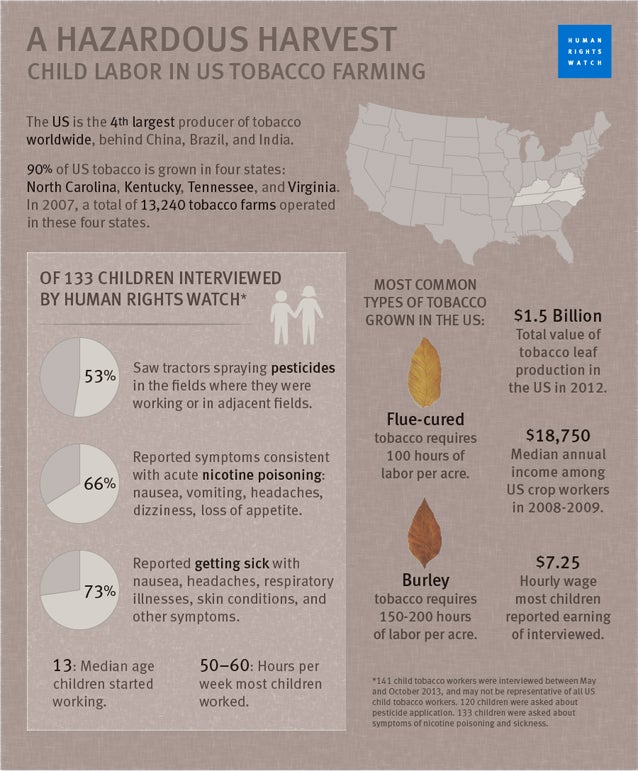
Made in the USA: Child Labor and Tobacco

Dangerous farming equipment, extreme temperatures, exposure to toxic chemicals and pesticides, very low pay, young kids working 12+ hour days. Sounds like the description of cheap labor on foreign farms that produce as much as they can at the lowest possible cost- despite the impact on the employees.

That is exactly what is happening, only it's NOT foreign.
It's happening right here in the United States.

In Kentucky, North Carolina, Tennessee, and Virginia U.S. tobacco farms are employing children as young as 12 years old to work on tobacco farms. And all the big tobacco manufacturers and merchants are benefiting from buying the product. Alliance One, Altria (Philip Morris), British American Tobacco, China National Tobacco, Japan Tobacco Group, Lorillard, Philip Morris International, Reynolds American, Universal Corporation.

In an 8-minute documentary by Human Rights Watch (video below) called: US: Child Workers in Danger on Tobacco Farms, the harsh conditions and workers on these tobacco farms are shown.


With good intentions the "made in the U.S.A." movement spreading throughout the country is partially focused on stopping child labor. Instead of buying from other countries, we look for products made in the U.S.A. with a focus on supporting American jobs, the American economy, and saying no to foreign child labor. Unfortunately, exploiting children isn't exclusive to other countries. It's happening right here in the U.S.A.

Big tobacco profits from child labor in US tobacco fields. Take action now:  http://www.hrw.org/ChildFreeTobacco %23ChildFreeTobacco

So what can we do? How can we help?

Watch the documentary. Share the story. Talk with family and friends about the importance of kids being in school. Keep working to reduce tobacco use throughout the U.S.A. and the world. If the demand for tobacco goes away, there will be no need for the supply. Which in turn means there will be no need for cheap labor to produce it (ie. kids).


For more information on the topic take a look at the Human Rights Watch article,
US: Child Workers in Danger on Tobacco Farms | Human Rights Watch. (2014, May 14).

Thursday, September 11, 2014

Quit Help at CVS Health

Every time I think about CVS making the decision to remove tobacco from the power wall I get a surge of excitement! What a great step towards healthier communities!

Almost a month before the planned day to remove tobacco from shelves at CVS, tobacco disappeared from CVS shelves last week on September 3, 2014.

I have been asked, "what do you think will replace the tobacco products behind the counter?" a few times and was waiting to see what would happen. Would they move other products to fill the space? Magazines? Candy? What would it be like? At my local CVS store and all around the country, the change was incredible. Take a look at the photo I took at the Neenah CVS last week. The perfect replacement of tobacco- quit encouragement and help!


CVS is making a difference in our communities by promoting help to quit smoking and creating a healthier environment. You can spread the word and support CVS in their effort to make a healthier environment. Just grab a piece of paper and write out your #OneGoodReason to stay tobacco free. Take a photo of your reason and share it. Follow #OneGoodReason on Twitter, Facebook, or Instagram to see what other reasons people have to stay tobacco free

Take a look at our FACT youth (Calista, Ally, and Jamie) and advisers (Anna and Brenna) below. There are thousands of reasons to stay tobacco free. What's your #OneGoodReason


Thanks CVS. We are with you. Rock on!
-Anna

Friday, August 1, 2014

Summer Fun with FACT
and the re:TH!NK Youth Coalition


FACT and the re:TH!NK Youth Coalition has been (and will continue to be) busy this summer! Our foucs has been on tobacco prevention and community education. Check out the photos below to see what we've been up to and how YOU can get involved!

World No Tobacco Day Cigarette Butt Clean Up: Menominee Park

Tobacco use is the single most preventable cause of death globally and is currently responsible for 10% of adult deaths worldwide.

May 31 marked World No Tobacco Day 2014. Youth Coalition members decided that a cigarette butt clean up would be a great activity to do on this day. :)

The group met at Menominee Park and picked up cigarette butts and related cigarette litter around Little Oshkosh, the park pathways, boat landings, picnic areas, and along the lake shore by the beach. Pictured below are Ally Molinski, Anna Carpenter (FACT Youth Advisor), Jamie Constantine, and Brenna Root (Youth Coalition Coordinator). Grace Halstead and her mom also helped out but did not make it into the photo. The cigarette butts that were picked up in the park will be added to a display the Youth Coalition will use to educate the community about the importance of tobacco free areas and the environmental impact that cigarette butts have on the environment.

Find out more info about the World Health Organization and World No Tobacco Day across the United States here!


Environmental Scans: A Tobacco Environment Scavenger Hunt

Six youth coalition members took to the streets of Oshkosh and surveyed local convenience stores to find out what types of products the tobacco industry is trying to manipulate youth into buying. The tobacco industry, aka Big Tobacco, spends the majority of their marketing budget in the retail environment to attract new, young users to their products. Youth coalition members did and environmental scan of their community to see how these products are being marketed in Oshkosh. Pictured below are Kaylyn Stanek, Hannah Schacherl, and Branden Udulutch. Ally and Calista Molinski, and Rachel Lee also participated. 

Youth Coalition members found that Big Tobacco companies are placing their deadly products where youth will be exposed to them while shopping at gas stations. One youth member, Ally, was surprised to see the cigarillos in a colorful display right next to the door! Cigarillos are a type of "other tobacco product," OTP, and these products are targeted towards a youth audience with bright colors and fruit flavors. Find out more about Big Tobacco's Manipulicious Products here and play the Spot the Not game with FACT!


Oshkosh Riverwalk Cigarette Butt Clean Up

The re:TH!NK Youth Coalition and FACT teamed up to clean up cigarettes butts along the Oshkosh Riverwalk August. The group picked up cigarette butts and related cigarette litter along Riverwalk. Pictured below are Alex Udulutch, Kiersten Tosch, Sara Matuszak, Ally Molinski, and Jamie Constantine. Brenna Root (Youth Coalition Coordinator) also helped out but did not make it into the photo because she was taking it. :) The cigarette butts that were picked up in the park will be added to a display the Youth Coalition will use to educate the community about the importance of tobacco free areas and the environmental impact that cigarette butts have on the environment. 


More Exciting Upcoming Events!

Pollock Pool FACTivism
Wednesday, August 6, 2014
12-2pm

Youth Coalition Meetings
Tuesday, August 12, 2014
New Moon Cafe, Oshkosh

For more information and if you'd like to get involved with FACT and the re:TH!NK Youth Coalition, contact Brenna Root at broot@co.winnebago.wi.us

Blog written by Brenna Root - originally on http://rethinkwinnebago.blogspot.com/

Friday, April 25, 2014

The U.S. Food and Drug Administration (FDA) announced on Thursday (4/24/14) it's plan to extend it's control of tobacco products to include cigars, little cigars, dissolvable products, hookah, and e-cigarettes. The proposed rule would required people purchasing the tobacco product to show a photo ID and would prohibit the sale and purchase of the product to those under 18 as well as create a few other restrictions on the products.

By far the most newsworthy piece of the proposed regulation, e-cigarettes. Most likely if you listened to the morning news, checked a news website or social media page you heard something about the proposed regulation.

Let's run through what this proposed regulation looks like, specifically for e-cigarettes.

1. Current producers of e-cigarettes would be required to provide justification for remaining on the market, provide an ingredient list, and disclose the manufacturing process and scientific data.
2. New e-cigarette producers would be required to get FDA approval before being sold.
3. Selling e-cigarettes to minors would be illegal.
4. Selling e-cigarettes in vending machines in a place kids are allowed would be illegal.
5. Giving away free samples of e-cigarettes would be illegal.
6. E-cigarettes would have a warning label stating they contain nicotine, which is addictive.
7. E-cigarette manufacturers would be able to claim that their product provides reduced risk IF the FDA confirms scientific evidence supporting the claim, and confirms marketing the product will benefit public health.

Whew. That is a lot to take in. So, the FDA has proposed these new regulations and will be accepting public comment for 75 days, starting today (4/25/14). If you have thoughts on this issue I encourage you to be part of the process by submitting a comment to the FDA. We'll get more information posted once we have it.

For more information on the proposed ruling check out the information below.

FDA Press Release
FDA Proposed Regulation
CNN
New York Times
ABC News Video
NPR Blog


Wednesday, March 19, 2014

Kick Butts Day!

One of the best days in March has arrived! Today is Kick Butts Day! 

Kick Butts Day is a day of activism that empowers youth to stand out, speak up and seize control against Big Tobacco.

While tobacco prevention efforts have made great strides in the fight against tobacco, every day, more than 3,000 kids under 18 try smoking for the first time and 700 kids become new regular, daily smokers. Tobacco use continues to be the leading cause of preventable death in the U.S., killing more than 400,000 people every year.

On Kick Butts Day, youth throughout the U.S. raise awareness about the tobacco problem, encourage peers to be tobacco-free, and support effective solutions to reduce tobacco use.


Some of re:TH!NK's very own youth in the Winnebago FACT group made a huge impact at a local middle school in Oshkosh. The group created a display board with 2 FACTs about tobacco and had their classmates vote for which FACT they thought was the ugliest truth. 


The FACTs they chose: 

1. Urea is found in cat pee, it is also found in cigarettes.
2. Methane is found in dog poop, it is also found in cigarette smoke.


At the end of lunch the FACT group counted up the votes and (drum roll please...) here are the results!

80 votes for urea in cat pee

vs. 

117 votes for methane in dog poop 


Students found the FACT that methane is in dog poop and cigarette smoke more disgusting than the FACT that urea is in cat pee and in cigarettes. And the general consensus of the group is that both FACTs were super disgusting!

The event was a huge success! Students, teachers, and staff were all interested and involved. Thanks to the Winnebago FACT crew, Ms. K, and all those at Perry Tipler Middle School. Happy Kick Butts Day. Rock on!


Thursday, January 9, 2014

50th Anniversary of the Surgeon General's Historic Report

On January 11, 1964, the Surgeon General pronounced the health risks posed by cigarettes.
Fifty years ago tobacco ads featuring Fred Flintstone, athletes, and movie starts could be found all over in magazines and on TV. Smoke hung in the air of restaurants, bars, teachers lounges, offices, and airplane cabins. And there'd be a good chance that your family doctor was a smoker too. It's amazing how much we have learned in 50 years about the harms of tobacco products and smoking.
The turning point for tobacco prevention came on January 11, 1964 with the Surgeon General's Report. That Saturday morning, the U.S. Surgeon General Luther Terry released the official report linking smoking to illness and death - and suggesting the government should do something about it. 

In the decades that followed, warning labels were put on cigarette packs, cigarette commercials were banned, taxes were raised, and new restrictions were placed on where people could light up. 

Wisconsin has seen great progress in reducing tobacco’s burden.

  • High school smoking dropped from 33% in 2000 to an all-time low 13% in 2012
  • Wisconsin is healthier since the smoke-free law took effect in 2010
  • Since the smoke-free air law, bars and restaurants saw a decrease in unhealthy air, bartenders experience a decrease in respiratory health symptoms
  • The number of smoke-free homes in Wisconsin also increased from 74% to 80%
  • The state’s Wisconsin Tobacco Quit Line has fielded more than 200,000 calls

While great strides in tobacco prevention have been made over the last 50 years, tobacco's still a problem in Wisconsin, so we need to stay committed. More than 800,000 Wisconsinites are still smoking, and smoking kills more than 7,000 adults in Wisconsin each year. 

In order to prevent and reduce deaths from tobacco we need to reduce the amount of youth who start using tobacco. Each day about 14 Wisconsin kids become new smokers. Candy and fruit-flavored tobacco products that are more affordable are attracting the attention of our young people. 

Looking like candy, gum, and other products that appeal to youth these products have become much more popular among youth. A new CDC study found that nationally, 40% of youth smokers use flavored little cigars or cigarettes. 

These other tobacco products (OTPs) are harmful and addictive, plus they're marketed aggressively to youth and are inexpensive. The products hook youth early and keep them addicted. The candy and fruit-flavors disguise the tobacco underneath. But using any tobacco product has serious health risks, even if it is coated in candy flavors. OTPs are not safe, not fair, and not good for Wisconsin.


The blog post used info from this USA Today article for more info on the 50th Anniversary of the Surgeon Generals Report. 


Friday, September 20, 2013

e-cigarettes: A New Frontier for Big Tobacco Companies?

They are all over the media, celebrities are endorsing them, and yet without regulation from the Food and Drug Administration (FDA) e-cigarettes have no standards to follow or comply with. The short version- Americans know little about the risks associated with using e-cigarettes.

The Huffington Post published an article in early September - 9 Terribly Disturbing Things About Electronic Cigarettes The article gives a list to readers simply stating what is known about e-cigarettes.

        Biggest points from the article:
e-cigarettes contain toxic chemicals.  Specifically diethylene glycol, a chemical found in antifreeze.
Kids across the U.S. are able to purchase these products because there is little regulation and they can be purchased online.
Companies that produce e-cigarettes are creating them in delicious flavors like milkshake.
Laws regarding advertisement of cigarettes do not yet apply to e-cigarettes... meaning youth are able to see ads on tv, online, and anywhere they may go.


With so much unknown in the realm of e-cigarettes it is best to play it safe and stay away from using. re:TH!NK also encourages you to do your own research and learn more about these products if you are interested, make sure to look at credible sources (example: www.iheartecigs.com might not be the best place to find and read unbiased information ;).

Tuesday, June 4, 2013

World No Tobacco Day wrapped up the month of May in style on May 31st.  The theme this year: ban tobacco advertising, promotion and sponsorship.  World wide people looked over policies regarding tobacco and highlighted the improtance of make changes toward a comprehensive tobacco policies. 

If you or someone you know is looking to quit tobacco check out some of the below smart phone applications... a high tech way to help quit!

  1. Since iQuit: This nifty app tells you how long it's been since you tossed your cigs aside, how much money you've saved (in euro, if you you're a super fancy type who buys those Gauloises abroad) and allows you to share your info with the world if you choose via Twitter, Facebook, email or text. Oh, and you can opt for your tobacco of choice: cigarettes, pipes or cigars.]
  2. No Smokes: An interactive quiz asking you how long you've smoked, how much you smoke, why you want to quit, when you're quitting. You're asked to choose whether you're Aboriginal or a Torres Strait Islander or both or neither, though the answers don't seem to change much no matter how you answer this question. At the end of the quiz, which is navigated by a computer-generated voice with an endearing Australian accent, you're given suggestions on how to approach quitting. After that, you're on your own with this one.
  3. Zombie Smokeout: A Zombie-themed video game developed by the American Cancer Society. You are the super heroine out to douse the world's secondhand smoke. You jump over smoking Zombies. If you miss, you are enveloped in a deadly cloud of Zombie smoke. It's a distraction. And a pretty good one.
  4. My Last Cigarette: This is the "Scared Straight" app. It shows you how much you've reduced your risk of heart attack and lung cancer and the number of people who died from smoking-related deaths since you tossed your cigs. It also tallies your savings and the number of cigarettes you've opted not to smoke. (Downside: Lots of advertisements, though there's a 99 cent version that makes the ads go away.)
  5. Quit Pro: A simple interface tells you how much time since you've quit, how much you've saved, how many hours of life you've gained. It also helps you identify triggers -- hunger, stress, boredom -- as well as motivators for continuing to live a tobacco-free life.

Tuesday, February 19, 2013

Smoking and Mental Illness

The Centers for Disease Control and Prevention (CDC) release a report this month highlighting the connection between smoking and mental illness. The report explains that those with mental illness have an especially high smoking rate. 

1 in 3 adults with a mental illness smoke, compared with 1 in 5 adults without a mental illness. 


According to the Substance Abuse and Mental Health Services Administration (SAMHSA) about 45.6 million people have a mental illness, meaning over 16 million adults with mental illness smoke. People with mental illness generally use smoking as a way of coping with the anxiety and stress of their mental illness and according to smoke experts, smoking has been accepted as part of the mental health scene for decades.

Many people with mental illness are at greater risk of dying earlier from smoking than dying from their mental health condition, Tom Frieden, director of the CDC, told reporters during a teleconference after the CDC released its report Tuesday. "This is a big mental health disparity and a vulnerable population, and we need to do more for smokers with mental illness," Frieden said. 

For more information about smoking and mental illness visit the CDC's Vital Signs at-
http://www.cdc.gov/vitalsigns/SmokingAndMentalIllness/index.html#RelatedLinks


Check out the Wisconsin program that helps those with mental health or substance abuse issues quit smoking (www.HelpUsQuit.org), including a video featuring patients talking about the issue. The program's formal name is the Wisconsin Nicotine Treatment Integration Project.

For quitting assistance, call 1-800-QUIT-NOW (800-784-8669) or visit www.smokefree.gov.
Also, visit www.BeTobaccoFree.gov for information on quitting and preventing children from using tobacco.

A GREAT article from the Milwaukee Journal Sentinel -
http://www.jsonline.com/features/health/smoking-more-common-among-mentally-ill-se8lmn4-189949731.html

Thursday, December 27, 2012

Youth Smoking Drops from 17.7% (2010) to 13.1%(2012)

It is great to know our efforts are working! A recent release by the Youth Tobacco Survey in Wisconsin declared that high school smoking went from 17.7% to 13.1%. In 2000, these numbers were at a whopping 32.9%!! Using a comprehensive tobacco control program, we have been able to reduce tobacco use and protect the public from secondhand smoke. Comprehensive programs include different approaches to tobacco control, not just one or few.

Having coalitions like re:TH!NK meet with legislators regarding policy change- such as raising cigarette taxes, FACT (Fighting Against Corporate Tobacco) groups around the state encouraging youth never to begin smoking, and WI Wins programs restricting access of tobacco products to minors all make a huge difference in seeing the decrease in youth and teen smoking. Middle school students rates have also went down-from 3.9% in 2010 to 2.5% in 2012. This can make a world of difference in our future as most smokers (90%) start before the age of 18.

We definitely are on the verge of reducing tobacco's burden on our state, resulting in lower health care costs and healthier people who will not suffer from tobacco-related illnesses!

Thursday, November 8, 2012

Study suggests that Smoker's Addiction is Left in DNA

A study suggested at the NCRI Cancer conference thast a smoker's addictoin may leave a mark in their DNA, although the genetic code stays the same. This may allow future findings to measure a smoker's risk for cancer. Researchers found that the DNA of the blood can be tagged chemically as the result of smoking. The tags can be detected in lung tissue, and can be used to find the increased risk of cancers related to lung, bowel and breast.

The tags gradually diminsh as someone quits smoking, according to lead researcher James Flanagan of Imperial College London. The tags are found the surface of the DNA. Although the tags may slowly disappear, the DNA of a former smoker will never exactly match the DNA of a non-smoker-something to always think about! Flanagan said that this will give a better story through their life and how their habit has changed throughout the years.

Dr Jane Cope, director of the NCRI, said: “This reinforces the message that smoking doesn’t just affect the risk of lung cancer, it can increase the risk of more than a dozen different cancers. Smokers lose around a decade of life and, along with many other benefits, giving up will mean the added risk of cancer drops off over time.”

Tuesday, September 4, 2012

US Court to Appeal Graphic Warning Labels on Cigarette Products

A court ruling against graphic cigarette labeling has been upheld in the federal government as of last week, giving the Big Tobacco Companies a "win". In June, the FDA unveiled 9 graphic warning ads to be printed on every package of cigarettes sold in the U.S. starting in October. Along with each different advertisement of diseased lungs, a crying baby, a man smoking through a hole in his throat, and others, the toll free number to help people quit smoking was also included to help those that already do smoke or use tobacco products, to find a way to quit.

FDA officials wanted these ads to explicitly focus on the dangers of smoking and to serve as motivation to quit and deter others from starting by seeing these images. In 2009, the FDA was given the authority to regulate tobacco products, and part of that law called for new graphic warnings. The major tobacco companies sued the goverment and said it violated the First Amendment, and got the ads blocked from being printed on their products, for now.

It is by no means the final word though on new cigarette warnings. The labels serve as disclaimers to the public regarding the health consequences of using tobacco products. There are current text-only warnings that are very stale and have gone unnoticed-they haven't been updated since 1984! Because of evidence that large graphic warnings are most effective at informing consumers about health risks of smoking, 43 other countries require large, graphic cigarette warnings.

Companies continue to spend billions of dollars to play down the health risks of smoking and to glamourize tobacco use, especially in youth. These graphic warnings tell the truth about how deadly it is. They will provide powerful incentive for smokers to take life saving steps to quitting and for youth to not even bother to try that first cigarette! "Studies around the world and evidence presented to the FDA also show that large, graphic warnings, like those adopted by the FDA, are most effective at informing consumers about health risks of smoking, discouraging children and other nonsmokers from starting to smoke, and motivating smokers to quit," said Matthew L. Myers, president of Campaign for Tobacco-Free Kids.